
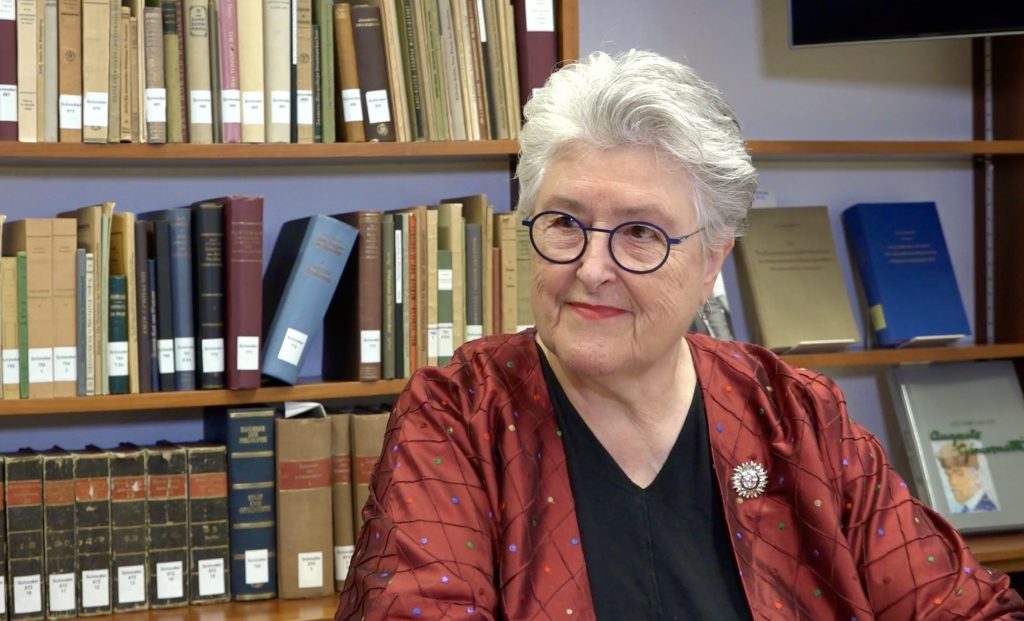
“Not where do I want to go, or what position do I need, but what are the interesting issues, where am I needed”.
This statement by Zita Küng expresses an attitude that has decisively shaped her life path and her social engagement. Growing up as the third child in a working-class household on the outskirts of Zurich, she developed an early desire to make a difference. Although no one in her family had attended university, her educational path was marked by self-initiative from the very beginning. Her experiences at school and the social upheavals of the late 1960s and early 1970s awakened her interest in political questions and, in particular, in the position of women in society.
Zita Küng’s professional career was anything but linear. After training as a primary school teacher, she studied voice at the Conservatory in Bern before deciding to study law. These different stages were closely tied to her interests and to the social conditions of the time. While music opened an artistic perspective for her, law allowed her to engage professionally with political and social questions as well. At the centre of her thinking was always the question of where injustice exists and how existing conditions can be changed. Her approach to law does not start primarily from the law itself, but from the feeling that something is unjust and must change.
One focus of her work was the fight for women’s self-determination and rights. As early as the 1970s, she campaigned for a new regulation of abortion, for better conditions around motherhood and childcare, and for a fundamental change in social gender relations. As a co-founder and active representative of feminist organisations, she worked to make women’s concerns politically visible and legally recognised. Her commitment led her, among other things, to the Zurich cantonal parliament and later to the Office for the Equality of Women and Men of the City of Zurich. The Swiss women’s strike of 14 June 1991, in whose organisation she took part, held particular significance for her. In her view, the broad mobilisation demonstrated impressively that women are not only present in society but that their concerns must be taken seriously.
In her later work as a feminist lawyer, consultant and mediator of knowledge, critical engagement with existing structures remained central. Through her commitment to feminist legal scholarship and to passing on feminist history, she repeatedly asked whether legal rules do justice to women’s actual living realities. For her, it is not only a matter of pointing out existing inequalities, but also of developing alternative solutions and prompting social change. The interview paints the portrait of a woman who has combined diverse professional paths with consistent political commitment. Zita Küng’s life story illustrates how impulses for social change can arise from a personal sense of justice, critical reflection and collective collaboration. Her conviction that a peaceful and solidary society needs the perspectives and knowledge of all people forms the common thread of her work.